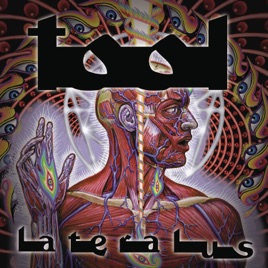
Released in May 2001, Tool's Lateralus represents one of the most complex attempts to fuse the structural rigor of progressive rock with contemporary ritual practices and metaphysics. Moving away from the visceral aggression and introspective rage of their earlier work, the American band engineered a sonic machine dedicated to transcendence and the reprogramming of perception, turning the record itself into an esoteric artifact. The album's compositional architecture is deeply bound to precise mathematical and geometric principles, most famously showcased in the title track, which incorporates the Fibonacci sequence into its time signatures and vocal syllable structure. Danny Carey’s complex rhythmic frameworks and hypnotic polyrhythms, coupled with Justin Chancellor's pulsing basslines and Adam Jones' razor-sharp riffs, establish a vibrational matrix engineered to alter the listener's state of consciousness and induce controlled trance. Maynard James Keenan's lyrical and vocal performance draws extensively from alchemy, Jungian analytical psychology, and theories of somatic transformation. Tracks such as The Grudge, Schism, and the closing triptych Disposition/Reflection/Triad explore the dissolution of the ego, suffering as a transformative catalyst, and the merging of matter and spirit, transcending conventional song structures to act as stages of an initiatory journey. Within the framework of the site, Lateralus connects directly to Dossier 13 (Occulture/Chaos Magick contemporanea). Tool’s work functions as a fully realized sigil technology: the sound, the sacred geometry of Alex Grey’s visual artwork, and the mathematical patterns within the compositions operate similarly to chaos magick, where symbols and rhythms are charged to rewrite subjective reality. The album treats sound as a vector of intent, transforming heavy rock into an instrument of technical and ritual gnosis. Lateralus stands as a unique monument in early 2000s music, bridging technical mastery in prog and metal with a profound investigation into contemporary occulture. With this album, Tool demonstrated how esotericism could evolve from mere aesthetic imagery into an operational method for structural and conceptual creation.
L'IA sta riascoltando l'album per te...