Official Review
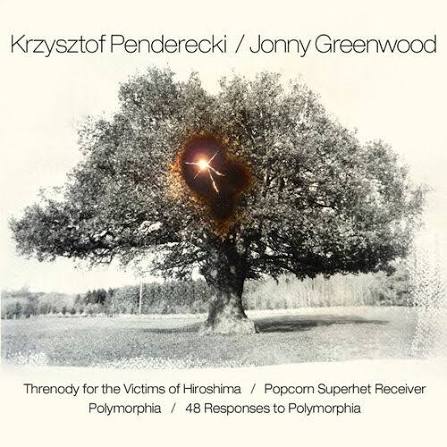
Composed in 1960 and recorded for Philips, Threnody to the Victims of Hiroshima was born under a different title: Penderecki originally called it simply "8'37," a reference to the piece's duration, conceived as an almost abstract exercise in the timbral possibilities of a string orchestra treated as an undifferentiated sonic mass rather than a collection of individual instruments. The composer himself later recounted choosing the dedication to the victims of Hiroshima only after re-listening to the recording and recognizing in it an emotional intensity the technical title didn't convey.
The score for 52 string instruments almost entirely abandons traditional musical notation in favor of graphic notation: colored bands, wavy lines, zones indicated by density and register rather than precise pitch. The performers produce microtonal clusters, extreme glissandi, percussion on the body of the instrument, overtone harmonics — a sonic vocabulary that treats noise and pitched sound as a continuum, not as separate categories. The result is a sonic mass that moves through accumulation and dissolution, without recognizable melody, functional harmony, or a stable rhythmic pulse.
It's precisely this absence of conventional narrative structure that makes the piece an especially direct case study for the dossier on Reza Negarestani and his ontology of horror: there's no subject narrating the event here, no voice mediating the experience for the listener. There's a sonic system producing a material intensity — friction, mass, texture — directly proportional to the scale of the event it names, without passing through representation. The title itself, added after the fact to material that hadn't been conceived to represent anything, is already an act that refuses narration in favor of the brute presence of sound.
The piece, which became ubiquitous in cinema (from The Shining to Hiroshima mon amour to countless documentaries) precisely for this capacity to evoke horror without illustrating it, remains, more than sixty years on, one of the most radical pieces ever written for string orchestra — a work that redefined what an orchestra could sound like, long before electronics made that timbral language familiar.
✍️ CP —
02/10/2026