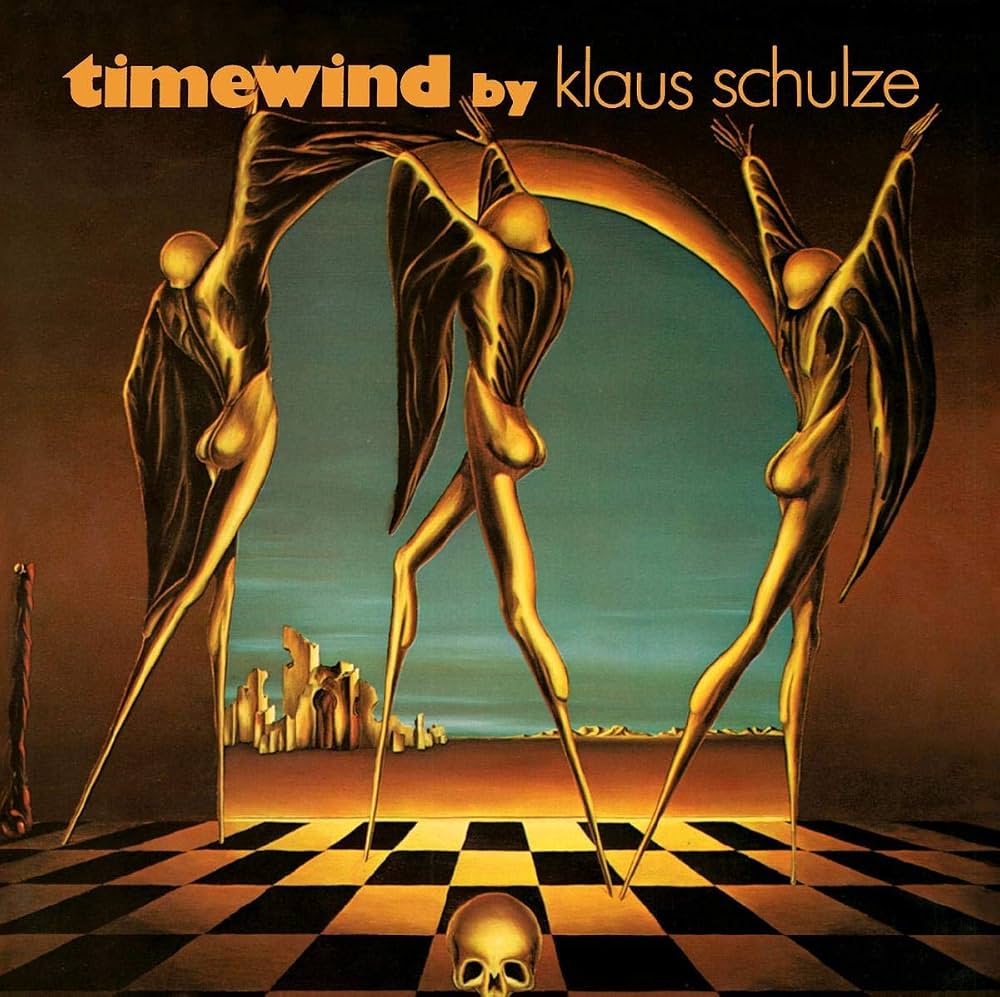
Released by Brain in 1975, Timewind is Klaus Schulze's fourth solo album and marks a synthesis point in his research into the analog sequencer as an autonomous compositional tool, no longer a simple rhythmic support but the generator of the track's entire architecture. The record consists of just two pieces, "Bayreuth Return" and "Wahnfried 1883," each filling an entire side of the original vinyl, both built on pulsing sequences from the Synthanorma Sequenzer, which Schulze had helped develop around that same time. The titles point to Richard Wagner — Bayreuth is the city of his theater, Wahnfried the villa where he lived — but the connection to the nineteenth-century composer isn't thematic in a narrative sense: Schulze inherits his ambition to build a dilated sonic time, in which duration itself becomes the work's content more than any melodic development. The hypnotic sequence that opens "Bayreuth Return" transforms over nearly half an hour through minimal envelope and filter variations, while the pipe organ, played by Schulze himself, enters to graft an almost sacred register onto a rhythmic fabric that remains stubbornly mechanical. It's a record that works on the perception of time more directly than most contemporary music: the listener quickly loses their bearing on the track's real duration, absorbed into an extended present that promises neither climax nor resolution. In this sense Timewind anticipates, for whole subsequent generations — from kosmische musik to the most hypnotic strains of techno, to certain currents of contemporary ambient — a listening model built on suspension rather than narration. We won't force a connection to the site's dossiers here: although this is a record obsessed with time from its very title, the relationship Schulze builds with duration is exquisitely phenomenological — an experience of perceptual dilation — rather than theoretical or systemic, and it doesn't find a precise anchor in the themes of acceleration, simulation, or infrastructural collapse running through the rest of the site's theoretical catalogue. Fifty years after its release, Timewind remains one of the high points of German kosmische musik, a record that redefined what a "song" could mean in a purely electronic context, well before club electronics made that language familiar to a mass audience.
L'IA sta riascoltando l'album per te...