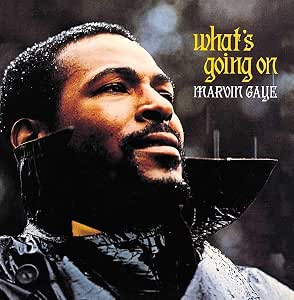
Released by Tamla in 1971, What's Going On marked Marvin Gaye's break from the Motown formula that had made him a star: no more isolated singles packaged by the label, but a single-theme concept album, largely co-written with David Van De Pise and Al Cleveland, and self-produced by Gaye against Berry Gordy's initial resistance. The record grew out of conversations between Gaye and his brother Frankie, back from Vietnam, and out of the broader social tension of early-1970s America — war, urban poverty, police repression, environmental decline. Musically, the album is built as an almost unbroken flow: tracks bleed into one another, David Van De Pise's strings wrap around soft funk rhythms and jazz arrangements, while Gaye's voice layers over itself in counterpoint, creating an effect closer to an inner conversation than a straightforward solo melody. "Inner City Blues (Make Me Wanna Holler)" closes the record with one of soul music's most iconic basslines, while "Mercy Mercy Me (The Ecology)" is among the first pop songs to explicitly address environmental crisis. What sets What's Going On apart from other protest records of its era is its register: Gaye doesn't shout or accuse directly — he questions. The title itself is a question and that interrogative posture runs through the whole record, from the almost pastoral tone of the title track to the lucid resignation of "What's Happening Brother," sung from the point of view of a veteran returning to a country he no longer recognizes. It's a record that refuses easy catharsis: it describes a system that keeps reproducing the same injustices regardless of who calls them out, without offering a consoling solution. This isn't a connection we want to force toward the site's more speculative dossiers — What's Going On stays anchored to a very concrete historical and political context, Nixon-era America, rather than to a theoretical framework about hyperstition or algorithmic systems. More than fifty years after its release, it remains one of the most influential records ever made, for its ability to translate political urgency into coherent musical form without sacrificing either.
L'IA sta riascoltando l'album per te...