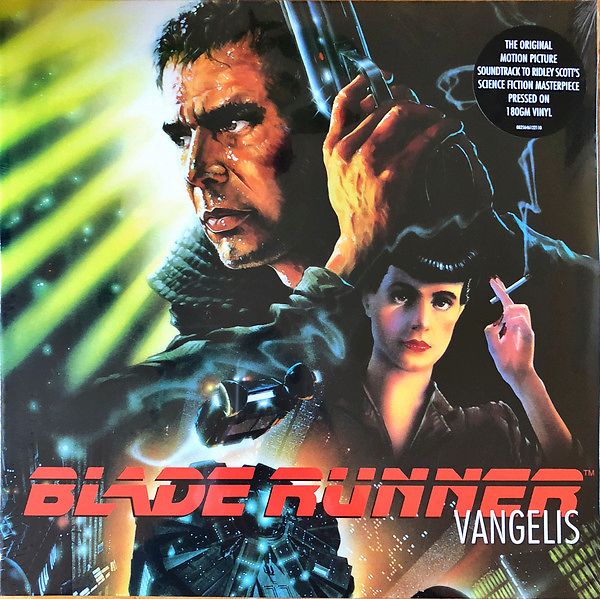
Vangelis Papathanassiou came to the project fresh off the success of Chariots of Fire, and Ridley Scott asked him for a soundtrack that wouldn't sound like a traditional film score, but rather like a continuous sonic environment—something existing within the same perceptual space as the imagery rather than commenting on it from the outside. The result is so deeply integrated into the visual texture of the film that the official soundtrack went unreleased for over a decade, with only orchestral covers and bootlegs circulating until the authorized release in 1994. Main Titles opens with a synth theme slowly moving over a repeated pattern, while the opening frames of the film show smokestacks spewing fire over the Los Angeles of 2019—the music generates the industrial image as a state of mind. Blade Runner Blues, built around a synth saxophone played by Vangelis himself, becomes the film's most immediately recognizable theme: melancholic, almost jazz-like, yet produced entirely by machines. Tears in Rain closes the record by underscoring Roy Batty's famous monologue, with a sonic bed that suspends all harmonic resolution, leaving the track—and the film—in a state of permanent openness. The dossier on William Gibson in this archive explicitly cites Blade Runner as a work that shares the imagery of literary cyberpunk despite preceding it chronologically: Neuromancer was published in 1984, two years after the film, yet both universes—acid rain, neon, worn-out technology mixed with urban poverty—seem to spring from the exact same source. Vangelis's album is the sonic proof of that convergence: rather than illustrating an already codifed genre, it is actively codifying it at the very same moment Gibson's novel would do so in prose. It is a case of double hyperstition—the aesthetic of a future that never arrived which, through nearly contemporaneous yet independent film and literature, nevertheless became the standard visual and sonic vocabulary for imagining "the future" over the next four decades. Today, the soundtrack remains one of the most cited touchstones for the fusion of synth and orchestra, as well as the implicit sonic model for much of the synthwave and ambient electronic music that explicitly draws from this genre.
L'IA sta riascoltando l'album per te...