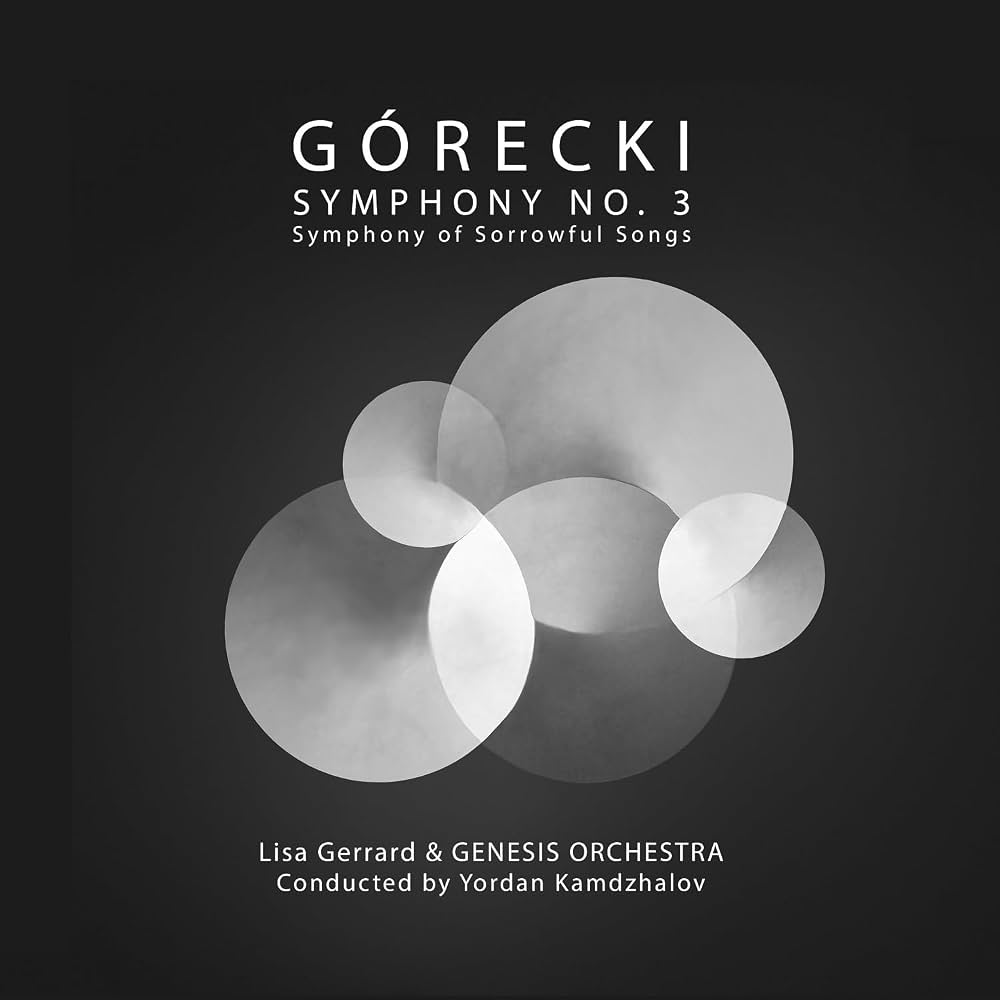
Official Review
Composed in 1976 and premiered in 1977, Henryk Górecki’s Symphony No. 3, Op. 36, widely known as the Symphony of Sorrowful Songs, stands as a watershed work in contemporary classical music. Structured across three slow movements, the symphony marks Górecki’s decisive shift away from the harsh, structural complexities of avant-garde serialism toward a radical, sacred essentialism. The orchestration stretches time through a rigorous modal counterpoint, where a simple melodic motif is repeated, layered, and expanded until it reaches an overwhelming emotional crescendo.
The composition is built around three distinct texts centered on separation, maternal grief, and mourning. The first movement, based on a 15th-century Polish Marian lament, opens with a monumental canon in the strings that gradually climbs from the lowest registers into the light before introducing the soprano voice. The second movement uses a prayer carved onto a Gestapo cell wall in Zakopane by an eighteen-year-old prisoner, while the third movement draws on a Silesian folk song about a mother searching for her son fallen in battle. The sonic material rejects decorative embellishment, focusing entirely on the purity of the elegiac register.
The global explosion of the album in the early 1990s—propelled by the legendary Nonesuch recording featuring Dawn Upshaw, David Zinman, and the London Sinfonietta—turned the piece into an unexpected cultural phenomenon. The hypnotic simplicity of its modular structures and the circular passage of musical time create a suspended listening space, where historical trauma is processed not through expressionist dissonance, but through static, painful contemplation.
Within the site’s framework, Symphony No. 3 connects directly to Dossier 2 (Mark Fisher / Cultural Melancholy). The work embodies a form of sacred hauntology and unresolved grief characteristic of post-historical sensitivity. The album's massive commercial success in the early 1990s, coinciding with the end of the Cold War and the consolidation of global capitalism, operates as a melancholic echo: a liturgy for the ghosts of the 20th century echoing inside an immobilized present, unable to imagine an alternative future.
Ultimately, the Symphony of Sorrowful Songs remains a landmark of 20th-century music, demonstrating how a return to tonality and contemplative rigor can serve as a profound existential inquiry. Górecki transformed individual and collective mourning into a monumental architecture of pure sound, offering a timeless meditation on memory, loss, and human endurance.
✍️ CP —
28/09/2026